 Commercial Building Disclosure (CBD)

Commercial Building Disclosure (CBD) is a national program designed to improve the energy efficiency of Australia’s large office buildings.
The disclosure requirements under the CBD program will commence on 1 November 2010.
The CBD program will ensure that credible and meaningful energy efficiency information is available to prospective purchasers and lessees of large commercial office space. Owners and lessors of commercial office space with a net lettable area of 2,000m² or more will be required to disclose energy efficiency information to prospective purchasers and tenants when the space is to be sold, leased or subleased.
Transitional Provisions
The legislation contains transitional provisions that will apply for the first twelve months of the program (i.e. from 1 November 2010 to 30 October 2011). During this period, a valid National Australian Built Environment Rating System (NABERS) Energy base or whole building rating, must be disclosed. After the transition period, a full Building Energy Efficiency Certificate (BEEC) is required to be disclosed.
Why does concrete crack?
Unlocking the mysteries of a critical building resource
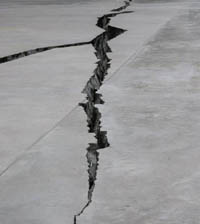 Concrete has been the main stay of building construction for generations. Today, traditional reinforced concrete is an integral and important component of building structures. It usually takes the form of footings in ground, slabs on ground, columns and suspended slabs.
Concrete however, is not the perfect substance. As such it can suffer from defects. These defects can have a huge impact on the appearance, capital expenditure, maintenance costs, safety and effective life of the total structure.
What then are the typical forms of concrete defects? Some of the more common defects can be categorised as follows:-
-
Structural design inadequacies – distortion, bending cracks, deflection, shear cracks, impact damage temperature change cracks, abrasion, torsion cracks and erosion.
-
Environmental causes – weathering/staining, biological growth, bacteriological attack, efflorescence (lime leaching), freeze-thaw damage and fire damage
-
Aggregate properties – aggregate swelling/shrinkage/softening, alkali-silica reaction and sulphide staining/spalling.
-
Chemical attack – sulphates, chlorides, acids and salt weathering.
-
Reinforcement corrosion – cracking, spalling and de-lamination
-
Concrete Cancer – cracking of the concrete caused by the corrosion of steel reinforcement in concrete structures
