 Another tall tale
There are a few candidates vying to become the world’s tallest building, however there is one that is rising above the competition.
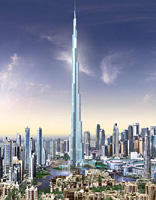 Burj Dubai (“Dubai Tower“) is a super-tall skyscraper currently under construction in Dubai, United Arab Emirates. According to its developers, It is currently the tallest free standing structure in the world, surpassing the CN Tower in Toronto, Ontario, Canada which previously held the record for 32 years. When it is completed in early 2009, it is predicted to be the tallest man-made structure in the world, as well as the tallest building by any measure.
While the final height of the building is a closely guarded secret, sources claim that it will measure approximately 818m, however this information is disputed.
Scheduled for occupancy in September 2009, the building is part of a 2 km² (0.8 sq mi) development called ‘Downtown Burj Dubai’ .
Burj Dubai’s last two milestones will be to surpass the 628.8 m (2,063 ft) height of the KVLY-TV Mast in North Dakota, United States to become the world’s tallest structure, and to pass the Warsaw radio mast in G?bin, Poland (646.4 m (2,121 ft) until it collapsed in 1991) to become the world’s tallest structure of any type ever built.
However, it is not simply the tall buildings that are making headlines.
The City Centre Las Vegas
The CityCenter will be a mixed-use 76-acre complex (16,797,000 square feet (1,560,500 m²)) on the Las Vegas Strip in Las Vegas, Nevada, currently under construction by MGM Mirage.
With a total cost expected to exceed $7.8 billion, CityCenter is the largest privately financed development in the United States. The original cost estimate was $4 billion, but it was pushed up by rising construction costs and design changes.
The project had an initial employee estimate of 12,000 people.
It’s easy being green
Green Ratings explained – why are they so important?
 For a famously outdoor nation, Australians generally spend a lot of time inside buildings. We take for granted the shelter, protection, warmth, coolness, air and light that buildings provide. However we rarely give a thought to the systems that deliver these services.
Few of us understand the environmental consequences of buildings, particularly from a commercial point of view. With the ever increasing global impact on our environment, there has never been a greater need for sustainable new and existing buildings.
So, what is involved in making our buildings more ‘green’?
Firstly, let us examine the facts around buildings within an environmental context. Buildings consume 32% of the world’s resources including 12% of its water. They produce 40% of landfill waste & 40% of air emissions. In essence, buildings are responsible for consuming 40% of the world’s energy. In Australia alone, buildings produce almost 9% of the national Greenhouse gas emissions. Clearly, buildings have a significant impact on the environment.
The problem seems obvious enough. How do you reduce the amount of energy buildings consume? Is it possible to measure buildings in this regard? The answer is yes. As to how this is done, the answer is Green ratings.
Green ratings rate how well a building design will perform environmentally. For example: by using less resources over their lifespan and reducing the environmental impacts that arise from constructing, operating and demolishing buildings, the total consumption of energy by buildings can be reduced.
A number of types of “green” rating tools exist for various applications. In particular, the Green Building Council of Australia’s (GBCA) suite of tools currently address commercial offices at all phases of development.
There are, or will be, rating tools for not only different building classes, (for example, office, retail, health, etc), there will also be rating tools for the different phases of the building life cycle, including stages such as design, fit-out and operation.
Various other rating tools have evolved to assess or predict building performance against certain criteria. These range from water & energy use to waste management and occupant satisfaction.
The basic aims of the rating tools are:
· to minimise the environmental impact of development,
· promote resource conservation,
· reduce energy use,
· establish a common language and standard of measurement for green buildings.
Apart from the obvious sustainability positives, another benefit of adopting rating systems is that they promote integrated whole building design. Whole building design considers all building components during the design phase. This integrates all the subsystems and parts of the building to work together. This approach brings together building design, energy efficiency, and solar technology to boost energy savings. It also makes the most of all building elements. It reduces the amount of energy required to operate a building compared to conventional building design.
Other benefits include: identifying life cycle impacts from a building’s planning and construction phase through to its use and eventual demolition; and improving built environments, often by reducing pollutants and ensuring the quality of air and water.
While “green” design may have an initial minor cost impost (up to 3%), their implementation generates many benefits and opportunities. These might come in the form of increased available floor area, lowered life cycle costs, the provision of healthier buildings that are more enjoyable to work or live in. They can also use pleasing architectural designs to brighten up work areas, using sunlight rather than electricity, without causing glare. The overall achievement reduces the amount of energy required to operate a building compared to conventional buildings
The benefits of ‘”green” buildings are significant in terms of increased sustainability. With the ever increasing global impacts on our environment, there has never been a greater need for sustainable new and existing buildings. Green ratings and green buildings are no longer just the future of the industry – they are today’s reality.
